


Dislocated knee: two very different situations
A dislocated knee occurs when the knee «comes out of place.» Behind this expression lie two injuries of very different severity:
- the patellar dislocation, by far the most frequent: the kneecap slips out of its groove to the side, then often pops back into place on its own;
- the knee dislocation Strictly speaking, rare but serious: the tibia moves relative to the femur, after a violent accident.
A simple sensation that the knee is giving way, without any visible displacement, is more likely due to instability related to a ligament: see Knee instability.
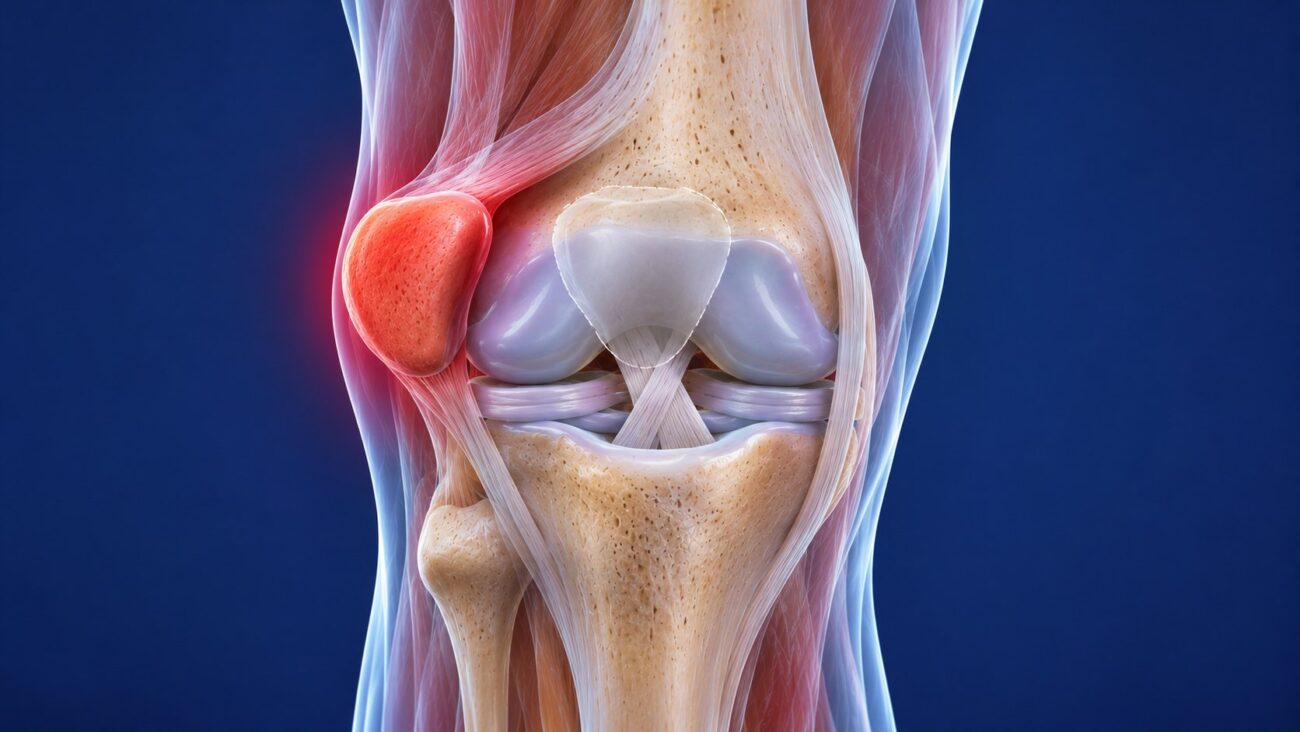
Patellar dislocation
How does it occur?
It most often occurs during a rotational movement, with the foot on the ground and the knee slightly bent: a change of direction in football, basketball, dancing, or a simple misstep. The kneecap moves outwards from the knee.
It mainly affects young adults, more often women. Certain characteristics predispose individuals to dislocations: a high-set kneecap, a shallow femoral groove, and flexible ligaments.
The signs
A dislocated kneecap can be recognized by several signs:
- a sharp pain and a feeling that «something has shifted»;
- a visible deformation, with the kneecap on the outside, if it has not returned to its original position;
- rapid swelling of the knee in the hours that follow;
- pain on the inner side of the kneecap, where the ligament that holds it has been stretched or torn.
Even if the kneecap pops back into place on its own, a dislocated knee with these signs always warrants a medical examination.
What should be done immediately?
When faced with a dislocated knee, the correct actions to take are as follows:
- do not attempt to put the kneecap back in place yourself if it remained displaced;
- immobilize the leg in the most comfortable position, often slightly bent;
- apply cold, without pressing on the knee;
- Seek emergency medical attention, or call 144 if the pain is severe or the person cannot be transported.
Even if the kneecap has popped back into place on its own, a dislocated knee should always be examined: the dislocation can tear a fragment of cartilage or bone from inside the knee.
While waiting for emergency services or transport, do not force your leg to straighten and do not put weight on your foot if the pain is severe. Avoid eating or drinking as long as a procedure under anesthesia is still possible.
The assessment after a dislocated kneecap
After a dislocated knee, an X-ray checks the position of the kneecap and looks for any bone fragments.’MRI It assesses the ligament that holds the kneecap (medial patellofemoral ligament) and the condition of the cartilage. It also helps to identify anatomical features that predispose to recurrence.
The doctor also examines the stability of the kneecap, the alignment of the leg, and the flexibility of the ligaments. Certain characteristics, such as a kneecap positioned too high, a shallow trochlear groove in the femur (trochlear dysplasia), or a patellar tendon inserted too far laterally, increase the risk of recurrence. Identifying these factors after the first dislocation allows for the most appropriate treatment and helps explain the risk of another episode.
What treatment?
After a first dislocation
In the absence of cartilage or bone fragments, treatment is most often conservative: a splint for a few weeks, then rehabilitation to strengthen the thigh, particularly the vastus medialis, and regain confidence in the knee.
When is surgery offered?
Intervention can be discussed in several cases:
- when a fragment of cartilage or bone has broken off;
- in case of repeated dislocations;
- when anatomical features make recurrence very likely.
The most common procedure involves reconstructing the ligament that holds the kneecap in place. More details in our article Patella surgery.
Knee dislocation: an absolute emergency
A true knee dislocation occurs during violent accidents: car accidents, falls from heights, or high-speed skiing accidents. Several ligaments are torn, and the artery behind the knee may be damaged. This is the most serious form of dislocated knee.
Call 144 If your knee is deformed after a violent accident, if your leg is cold, pale, or numb, or if you experience very intense pain, it's essential to monitor your blood vessels. Even if the knee seems to have returned to normal, monitoring them is crucial.
In the emergency room, the dislocated knee is put back in place, and then the leg's circulation is checked with an imaging scan of the blood vessels. An MRI then assesses the torn ligaments. Treatment is most often surgical, involving the reconstruction of several ligaments, and recovery takes months.
How long does it take to recover?
After a first patellar dislocation Treated without surgery, resuming daily activities takes a few weeks, and returning to sports approximately two to three months. After ligament reconstruction, it generally takes four to six months before returning to pivoting sports.
During rehabilitation for a dislocated knee, the goals are to regain full mobility, strengthen the thigh and hip, and then work on balance and weight-bearing. Returning to sports isn't just about setting a date; it's permitted when the knee swelling has subsided, strength has returned, and confidence is restored during jumps and changes of direction. Returning too soon increases the risk of recurrence.
Frequently Asked Questions
Key takeaways
Here are the key points to remember when dealing with a dislocated knee:
- A knee that «dislocates» is most often a dislocation of the kneecap;
- You should not try to put it back in place yourself;
- Even when put back in place, it must be examined to check the cartilage;
- A true knee dislocation after a violent accident is a life-threatening emergency for the leg: call 144.
If you have any doubts after a dislocated knee, have it examined quickly.