
Knee injuries in snowboarding: different from skiing
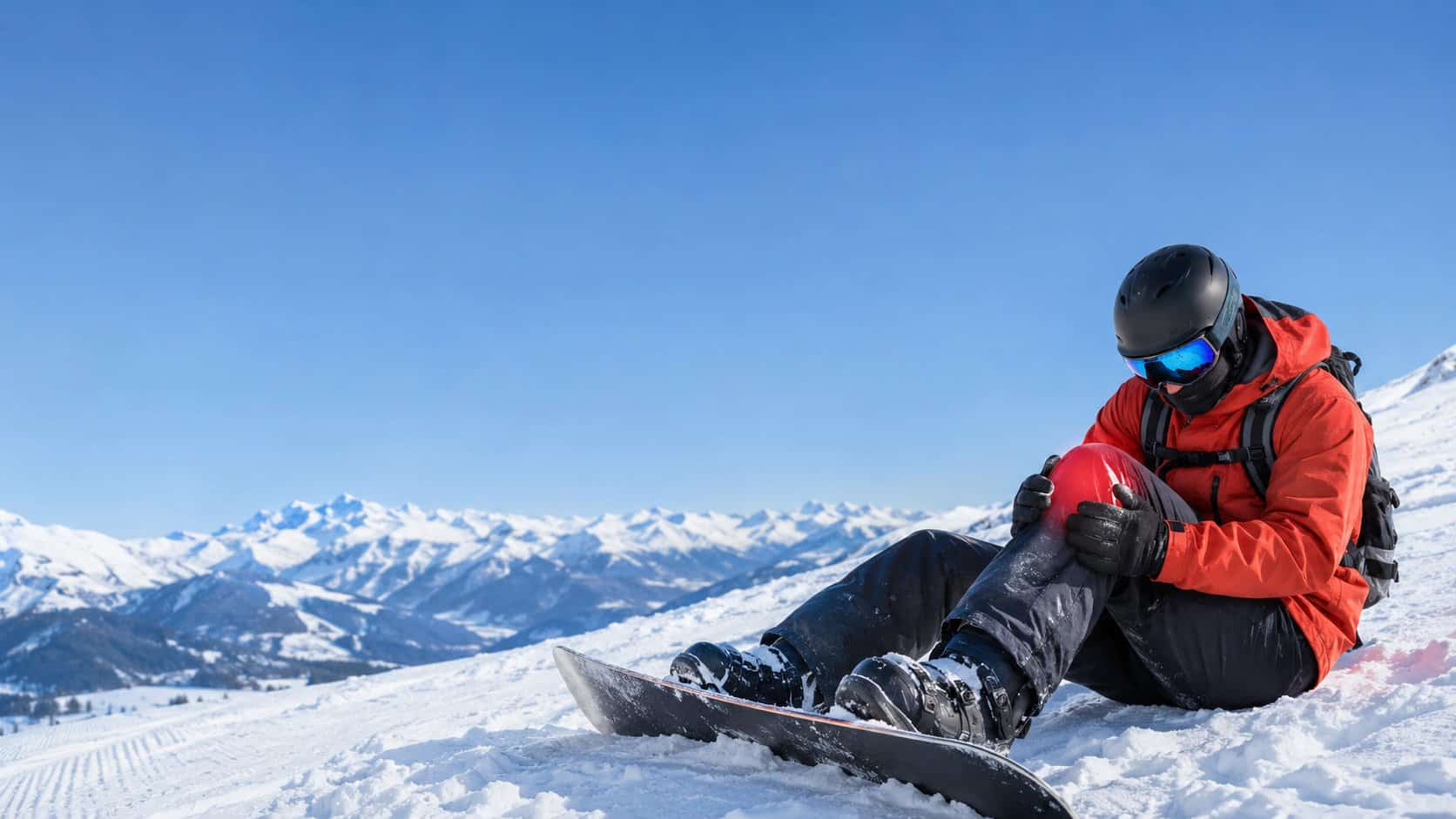
In snowboarding, both feet are fixed to the same board. Twists of one leg, typical of skiing, are therefore less common, and injuries more often affect the wrist, shoulder, or coccyx. However, the knee remains vulnerable in snowboarding, especially during jumps, hard landings, and falls, and injuries can sometimes be serious: ligaments, meniscus, kneecap, or fracture.
The profile of knee injuries in snowboarding also varies with skill level. Beginners fall frequently, at low speeds: they mainly injure their wrists and suffer bruises. Experienced riders reach higher speeds and jump in snowparks: their falls are less frequent but more violent, resulting in more ligament damage and fractures.
How does the knee get injured while snowboarding?
The landing of a jump
This is the most dangerous situation for the knee in snowboarding. When the rider lands with their legs too straight, back, or off balance, the knee absorbs a sudden impact and can twist. This is the typical mechanism for an anterior cruciate ligament (ACL) rupture in snowboarding, but also for tibial plateau fractures during very hard landings.
The «edge fault»
The edge of the board catches on the snow, and the rider is thrown abruptly forward or backward. The knee can then twist or hit the ground. These falls often occur on hard or uneven snow, and at the end of the day when fatigue makes balance less precise.
The descent from the chairlift
Upon exiting the chairlift, only one foot is attached to the board. If the rider loses their balance, the knee of the attached leg can be severely twisted, as the board doesn't follow the body's movement. This is a common cause of sprains among beginners.
Direct impacts
The knee in snowboarding also suffers direct impacts. A fall on your knees on icy snow, a collision with a feature in the snowpark, a tree, or another user can cause a contusion, a kneecap injury, or a fracture. Cold, fatigue, and poor visibility significantly increase the risk.
The most common knee injuries in snowboarding
Medial collateral ligament sprain
It occurs when the knee is forced inward, for example, when falling on a board that catches. The pain is located on the inner side of the knee, the swelling is often moderate, and walking remains possible, but painful. It most often heals without surgery. See our article on...’sprain of the medial collateral ligament (MCL).
Anterior cruciate ligament rupture
This anterior cruciate ligament rupture This occurs mainly upon landing from a jump or during a fall with a twisting motion. The rider often feels a cracking sound, then the knee swells rapidly in the following hours, giving a sensation of giving way. This condition warrants prompt medical attention. See the anterior cruciate ligament rupture.
Meniscus tear
Another knee injury in snowboarding: a landing in a bent position or a sudden rotation can tear the meniscus, the small cushion that absorbs shocks between the femur and tibia. This causes a localized pain in the joint line of the knee, sometimes catching or even locking. See the traumatic meniscus injuries.
Patellar dislocation
The kneecap can dislocate laterally during a fall involving knee rotation. It often pops back into place on its own, but an examination is still necessary because the dislocation can tear a fragment of cartilage or bone. See the patellar dislocation.
The contusion and the fracture
A direct fall onto the knee most often results in a simple contusion Pain, bruising, and slight swelling that improve within a few days. A very violent impact, however, can cause a tibial plateau fracture, with intense pain and the inability to put weight on the foot: it requires rapid treatment.
What to do immediately after a fall?
After a knee injury while snowboarding, the first instinct is to stop and not continue down the slope «to test» the knee. A knee injury that gives way a second time can worsen a ligament or meniscus tear. Get safely to the side of the slope and assess the pain and your ability to bear weight on the affected leg.
If you cannot descend without assistance, ask the ski patrol. In case of a serious accident, call the 144 in Switzerland or the 112 In France. Once down, apply cold, protected by a cloth for 15 to 20 minutes, elevate the leg and limit weight-bearing if walking is painful.
When should you seek medical help quickly?
After a knee injury while snowboarding, certain signs warrant immediate medical attention, ideally the same day or the following day. A popping sound followed by rapid swelling of the knee suggests a ligament rupture or fracture. A knee that gives way while walking indicates instability, often related to a cruciate ligament injury.
A locked knee, unable to fully straighten, may indicate a fragment of the meniscus lodged in the joint. Finally, any deformity, dislocated kneecap, or inability to bear weight on the foot requires urgent examination and X-ray.
Diagnosis and treatments
After a knee injury while snowboarding, the examination helps guide the diagnosis: location of the pain, stability, mobility. It is supplemented by an X-ray to rule out a fracture and often by a Knee MRI to see the ligaments, meniscus and cartilage.
Most knee injuries from snowboarding can be treated without surgery: relative rest, a brace if needed, followed by physiotherapy to regain mobility and strength. Some injuries, such as a torn anterior cruciate ligament (ACL) in an active rider or a displaced fracture, may require surgery. The decision is made in consultation with the surgeon, depending on your activities and goals.
How long does it take to heal?
For a knee injury while snowboarding, everything depends on the type of injury. A contusion usually heals in a few days to a few weeks. A mild sprain generally requires a few weeks of relative rest and rehabilitation before returning to snowboarding.
A torn cruciate ligament, a significant meniscus tear, or a fracture requires several months before returning to snowboarding, with or without surgery. Resumption of activity is only possible once the knee is pain-free, stable, and leg strength has returned, after approval from a doctor or physiotherapist.
Preventing knee injuries while snowboarding
Prepare your body
To protect your knees while snowboarding, a few weeks of strengthening your thighs and glutes before the season, combined with balance exercises, will prepare your knees for impacts and landings. A warm-up of a few minutes before your first run also reduces the risk of injury.
Adjusting your equipment
In terms of equipment, poorly adjusted bindings, unsuitable angles, or a stance that's too wide or too narrow can strain your knees and increase the risk of falling. Have your board adjusted by a professional, especially if you're a beginner or if you're changing equipment.
Adapting one's practice
Learn how to fall and land jumps with slightly bent knees. Avoid jumps and the snowpark when you're tired, at the end of the day, or when the snow is hard. Padded knee pads protect against impacts, but not sprains.
Key takeaways
Snowboarding puts less strain on the knee than skiing, but a knee injury from snowboarding can still be serious. Four points should be kept in mind:
- Jumps and «edge faults» are the most risky situations;
- A cracking sound followed by rapid swelling should prompt a consultation within 24 to 48 hours;
- Most injuries can be treated without surgery, with rehabilitation;
- Good physical preparation and properly adjusted bindings reduce the risk.
If you experience knee pain while snowboarding or have any doubts after a fall, it is better to have your knee examined quickly than to resume snowboarding too soon.
Frequently Asked Questions
Is snowboarding less dangerous for the knee than skiing?
Knee injuries are generally less common in snowboarding than in skiing, because both feet are fixed to the same board. However, they do occur, especially during jumps and falls, and the wrist and shoulder are more frequently affected.
Can you tear your cruciate ligament while snowboarding?
Yes, especially during a poorly controlled landing from a jump, with legs too straight, or a fall involving a twisted knee. A cracking sound followed by rapid swelling should prompt a medical consultation.
Should you wear knee pads?
Padded knee pads protect against impacts and bruises when falling to one's knees. They do not protect against sprains or ligament ruptures.
Could binding settings play a role?
Yes. Incorrect mounting angles or a position that is too wide or too narrow can cause overload pain. Have your board adjusted by a professional, especially if you are a beginner.
When can I resume snowboarding after a knee sprain?
When the knee no longer hurts, is stable, and has regained strength in the thigh, after receiving approval from your doctor or physiotherapist, resume your activities on easy slopes, without jumps at first.
My knee swelled up immediately after a jump: what should I do?
Rapid swelling within hours may indicate a ligament rupture or fracture. Stop, protect the knee, apply ice, and seek medical help promptly, ideally the same day or the next.
Injured your knee while snowboarding? Consult a doctor in Geneva.
Dr. Coulin, an orthopedic surgeon specializing in the knee, receives patients in Geneva from Switzerland, neighboring France and abroad, to make the right diagnosis and offer appropriate treatment.
Make an appointment or call the +41 22 348 80 00.