
Understanding a major knee injury
A rupture of the anterior cruciate ligament, more commonly known by the abbreviation LCA This is one of the most frequent and debilitating knee injuries. It is particularly feared by athletes, as it often leads to a prolonged interruption of physical activity and, in many cases, requires surgery followed by a long rehabilitation.
However, this injury does not only affect elite athletes: it can also occur during amateur sports activities, or even in certain everyday life situations.
What is the anterior cruciate ligament ?
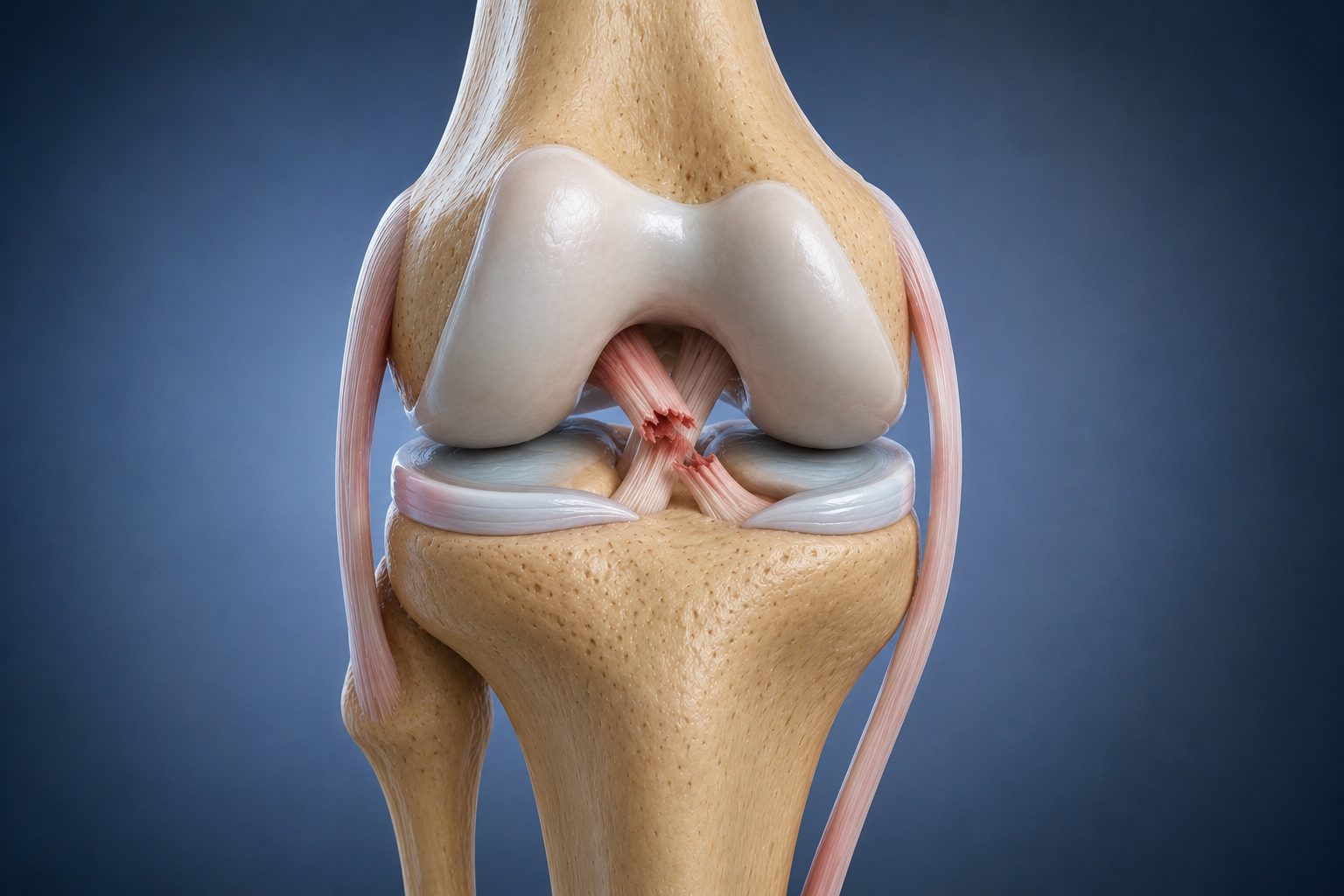
The knee is a complex joint that allows for flexion, extension, and slight rotational movements. This stability relies largely on a set of strong ligaments, including the anterior cruciate ligament (ACL). Located in the center of the joint, the ACL connects the femur to the tibia diagonally and prevents the tibia from sliding excessively forward.
Beyond its role as a mechanical "brake," the anterior cruciate ligament actively participates in controlling the rotational movements of the knee. It is particularly involved during changes of direction, pivots, and deceleration phases. When intact, it allows the knee to remain stable even during complex athletic movements. Conversely, when it ruptures, this stability is severely compromised, which explains the sensation of the knee "giving way" frequently reported by patients.
A common injury, especially in certain activities
Anterior cruciate ligament rupture is particularly common in sports that place intense stress on the lower limbs. It is frequently observed in disciplines involving jumping, landing, or rapid pivots.
It is found in particular in:
- football and rugby,
- basketball and handball,
- alpine skiing,
- certain combat sports or dance.
These sports combine pivots, changes of direction, and landings from jumps.
What is a rupture of the anterior cruciate ligament?
A rupture of the cruciate ligament usually occurs during aIndirect trauma.
- a sudden change of direction,
- an unbalanced landing from a jump
- a sudden deceleration.
These various factors can be enough to rupture the ligament if the stresses exerted exceed its resistance capacity. In these situations, the knee is subjected to significant torsional forces while slightly flexed, a position particularly vulnerable to the anterior cruciate ligament.
Less commonly, a direct blow to the knee, particularly during a tackle or violent contact, can cause the rupture. Whatever the cause, the injury often occurs suddenly and unexpectedly.
The symptoms: often telling signs
The symptoms of an anterior cruciate ligament (ACL) rupture typically appear suddenly. At the time of the injury, many patients describe a popping sensation or hear a clicking sound inside the knee. This sensation is frequently followed by sharp pain, forcing them to immediately stop the activity.
In the hours that follow, several signs may appear:
- rapid swelling of the knee, linked to hemarthrosis,
- a decrease in mobility,
- difficulty putting weight on the affected leg.
After the acute phase, the pain may lessen, but a feeling of instability persists. The knee may feel like it is "giving way," especially when walking briskly, going down stairs, or making twisting movements.
In the case of partial ruptures, the symptoms may be more subtle, which explains some delays in diagnosis.
How to make the diagnosis?
The diagnosis is based on a combination of clinical findings and additional tests. The clinical examination assesses knee stability using specific tests, such as the Lachman test or the anterior drawer test. These maneuvers can reveal abnormal tibial displacement.
However, imaging is often essential to confirm the suspicion. MRI is now the gold standard. It allows not only visualization of the anterior cruciate ligament rupture, but also detection of any associated injuries, such as meniscal or cartilage damage, which can influence the treatment strategy.
What are the treatment options?
The treatment of an ACL rupture depends on several parameters: age, activity level, the patient's functional goals, and the degree of knee instability. Two main approaches exist.
1. Conservative treatment
In some cases, non-surgical treatment may be considered. This is primarily intended for people who are not very active or whose knee remains stable in their daily life. This treatment is based on:
- an initial phase of rest and inflammation management,
- a thorough rehabilitation program aimed at strengthening the stabilizing muscles,
- Proprioceptive exercises to improve knee control.
It is important to clarify that this approach does not repair the torn ligament, but aims to compensate for its absence through good muscle control.
2. Surgical treatment
The surgery This procedure is often offered to young, active, or athletic patients, as well as those suffering from persistent instability. The surgery involves reconstructing the ligament using a tendon graft. It is performed arthroscopically and followed by rigorous rehabilitation.
Rehabilitation: a crucial step
Rehabilitation is a fundamental pillar of recovery, whether or not surgery has been performed. It extends over several months and follows a structured progression, including:
- the recovery of joint range of motion,
- progressive muscle strengthening,
- balance and coordination work,
- the supervised resumption of sporting activities.
Resuming sports activities generally takes between six and twelve months, depending on the type of activity and the quality of recovery.
Long-term risks
Without proper treatment, a ruptured anterior cruciate ligament can have lasting consequences on knee function. Chronic instability promotes repeated meniscal tears, accelerates cartilage wear, and increases the risk of developing early-onset osteoarthritis.
Appropriate care, combined with rigorous rehabilitation, helps to restore knee stability, limit long-term complications and preserve joint function in the long term.
Preventing ACL rupture
Prevention plays a major role, especially among athletes.
Specific programs incorporating muscle strengthening, jump technique work and proprioceptive exercises have demonstrated their effectiveness in significantly reducing the risk of injury.
ACL injury prevention relies on targeted physical preparation. Dr. Coulin recommends:
- muscle strengthening of the quadriceps, hamstrings, glutes and core muscles,
- training in proprioception and movement perception, to improve coordination and responsiveness,
- a suitable warm-up before any effort,
- and a gradual return to normal activity after an injury to avoid recurrence.
These measures significantly reduce the risk of ACL rupture.
Frequently Asked Questions
Should surgery be performed quickly after an ACL rupture?
No, ACL surgery is not an emergency. When indicated, it is generally performed after a few weeks, once the knee has reduced swelling and regained good mobility: operating on a still-swollen and stiff knee increases the risk of stiffness. However, the knee should be examined promptly to look for other injuries (meniscus, other ligaments), some of which require more immediate attention.
Is surgery always necessary?
No. The decision depends on age, sporting activities, occupation, and knee stability. A person who doesn't participate in pivoting sports and whose knee remains stable can often be treated with rehabilitation alone. Surgery is generally recommended in cases of instability or when a return to pivoting sports is desired.
Should I have an MRI?
Yes, most often. A clinical examination can suggest a tear; an MRI confirms it and looks for associated damage to the meniscus, cartilage, or other ligaments. This information is important for choosing the treatment.
When will I be able to walk again?
Most often, you can start walking again within a few days of the injury, sometimes with crutches initially, until the pain and swelling subside. Walking as soon as the pain allows helps maintain knee mobility and thigh strength. Avoid pivoting, jumping, and sudden changes of direction.
How long will I be off work?
It depends mainly on the job. For office work, the leave is often short, just until the pain and swelling subside. For physical work (prolonged standing, carrying heavy loads, climbing ladders), it's longer. The doctor will tailor the sick leave to your specific situation during your consultation.
Is it possible to drive with a torn ACL?
Not as long as the knee is painful, swollen, or unstable. For the right knee, you should be able to brake firmly without hesitation. For the left knee, with an automatic transmission, acceleration is often quicker. If in doubt, consult a doctor.
When will I be able to resume playing sports?
Activities without pivoting (cycling, swimming freestyle) can often be gradually resumed once the knee swelling has gone down, according to the advice of a doctor or physiotherapist. Sports involving pivoting, jumping, or contact (skiing, football, tennis, etc.) should not be resumed until treatment is determined: the knee could give way and damage the meniscus or cartilage.
What should I do while waiting for the consultation?
Relative rest, ice for 15 to 20 minutes several times a day, leg elevated, and crutches if needed. Avoid «testing» the knee by running or pivoting. For a quick consultation in Geneva: 022 348 80 00.
Need a quick opinion in Geneva? Make an appointment or call the 022 348 80 00.
Conclusion
A torn anterior cruciate ligament (ACL) does not mark the end of an active life. When diagnosed early and managed with a personalized approach, it can be treated effectively, with the goal of restoring a stable, functional, and long-lasting knee.
Since each patient is unique, an adapted therapeutic strategy, combined with quality rehabilitation, optimizes recovery, reduces the risk of complications and promotes a gradual return to activities under the best conditions.